Showing posts with label Spandrels. Show all posts

Thursday, July 21, 2016

Spandrels From Mythic Beasts

This week, another sneak peek at some kinds of magical "treasure" that animal PCs can earn and effectively turn into Species Traits.

The following spandrels are based on rumored abilities of some lesser-known mythical beasts.
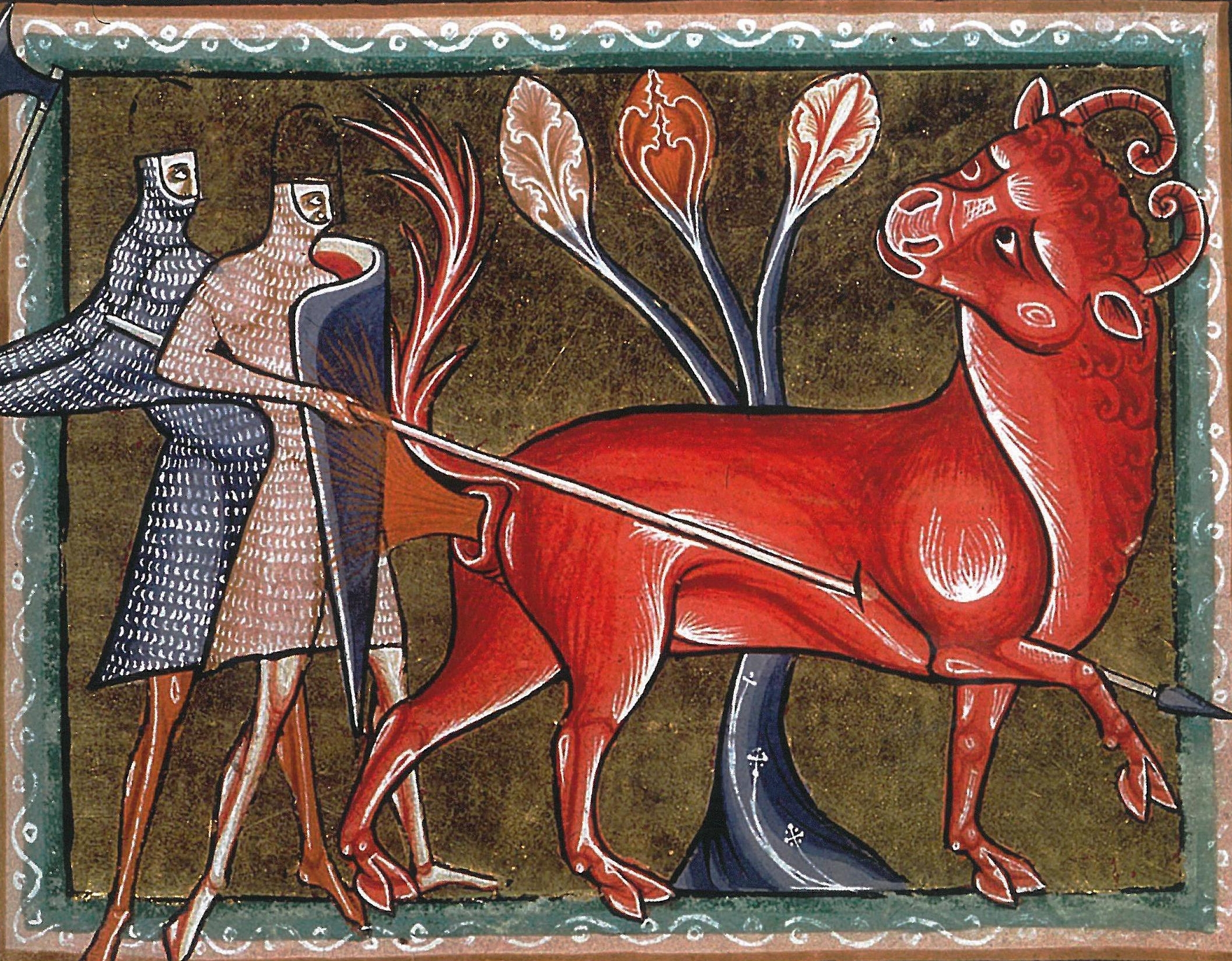
Bonnacon’s Hide (Pre-requisite: Must be a herd animal) 
You gain the burn-resistant ability of the legendary bonnacon, a herd beast with powers of acidic excrement.  This spandrel grants you resistance to acid and fire attacks; you only take half damage from such attacks, or one-quarter damage on a successful saving throw.

Bonnacon’s Scorching Dung (Pre-requisite: Must be a herd animal) 
The bonnacon is a mythical species of herd animal with a unique defense mechanism: when fleeing attacks, the bonnacon excretes a trail of acidic dung that scorches pursuers like fire. Some legends say a bonnacon could expel this dung in a stream or cone while passing gas, as well.

This spandrel grants you an area attack that spews from your anus, in a manner similar to a skunk’s musk attack.  It forms a 30 ft. by 30 ft. area of effect; all targets within this area must make Blast saves or suffer an amount of damage equal to your maximum HP on the first round of exposure.  Those who fail this initial saving throw must then make successful Tough Trauma save each round thereafter, or suffer the same damage again. This damage continues each round until the target makes a successful save. 

Targets who fail these saves can do nothing else on their turn except flail about in agony, until they succeed on a save.

Horns Of The Jackalope (Prerequisite: Must be a rabbit or other lagomorph) 
Three times per day, the rabbit can cause a pair of antlers, similar to those of a male deer, to appear on his or her forehead.  These antlers will behave in every way as though they were a normal part of the rabbit’s anatomy.  They inflict 1d7[1d8] hp of damage.  As long as the antlers are manifested, the rabbit can use them as her preferred arrack form, even if she chose another such attack for herself at the time of character creation.  In addition, Warriors can use the antlers as their specialized attack form, even if they normally use another attack form for this purpose.  The antlers manifest for 1 turn per Total Level of the rabbit.

Once per round, the bearer of the horns of the jackalope can emit a bone-chilling scream, like that of a human woman in agony.  Characters who fail an Average save vs. paralysis become so frightened by the sound of this scream that they suffer a –2 penalty on all core dice rolls for the next 1d5 [1d6] rounds.


Pantere’s Flowery Breath (Pre-requisite: Must be a cat of SZ Medium or above) 
You gain an unusual breath weapon, first displayed by the great cat of legend who served as a riding mount for decadent gods.  This spandrel enables you to belch forth a cloud of sweet-smelling gas that occupies a 30 ft. by 30 ft. space.  Any animal within this area of effect must  make a Challenging Charm save, or become enamored of you in a manner identical to the classic fantasy spell charm  person. This effect lasts for 24 hours.  You may use the flowery breath spandrel once per day for every 3 Total Levels you have achieved, to a maximum of three times per day.

Wednesday, December 30, 2015

The Foundling -- A Niche For Longpaw PCs

A majority of longpaw children lost or abandoned in the wild can expect little but a horrible death unless they are rescued by their kin or species-mates.  But sometimes -- just sometimes -- an orphaned human or demi-human child gets adopted by a community of beasts and reared as one of their own.

This niche is optional, but can be a great way to bring in players who simply aren't sold on the idea of animal PCs.  Let them play Mowgli or Tarzan instead!

The Foundling
On rare occasions, animals will adopt an orphaned human (or other longpaw) child as one of their own.  Such unique individuals will grow up to prefer the company of their animal family and its species, and have a great deal of trouble interacting with members of their own... especially if they have witnessed longpaw crimes against their adoptive animal family.  Nonetheless, they can become ambassadors of sorts between their parent species and their adoptive species.  Indeed, such Foundlings often become legendary heroes among longpaws, thanks to their unique abilities.

Niche Ability:  Select a Species Trait of your adoptive animal family. This ability is now an inherent trait for you, but comes at the expense of a normal longpaw trait, such as the Versatility of Men, the Tunnel Sense of dwarfs, the Fey Magic of elves, or the Halfling attack bonus with missile weapons.  The longpaw trait you lose and the animal trait you gain are both your choice, but remain permanent throughout your adventuring career.  

In most circumstances, you can use this new Species Trait as effectively as any actual member of your adoptive species.  You can also acquire spandrels based on this adoptive Species Trait, but otherwise must gain rewards and treasure in the standard longpaw ways.

Some Species Traits, such as natural flight or water breathing abilities, are only available in classic fantasy or other high-magic settings. 

Other Abilities:  Add your Foundling level (plus your Foundling niche die result, if any) to all lore checks involving communication between longpaws and your adoptive species, to attempts to communicate with animals other than longpaws and your adoptive species, to find food or water in your adoptive species' preferred habitat, and to applied knowledge about the the geography and other features of the wilderness where you grew up.

Saving Throw: Fear

Threat: Average (+6). This increases to Tough (+3) at 2nd total level, Challenging (+0) at 5th total level, and Formidable (–3) at 8th total level.

Sneak Peek: Spandrels

As I've noted, animal PCs tend not to collect magic items, per se.  But under the Great & Small rules, I've given them the option of internalizing magic items or claiming Species Traits from other animals as adventuring rewards.  I call this system "spandrels," after a term from evolutionary biology that refers to "accidental" or "side effect" traits of naturally-selected adaptations.

Most of the writing I'm doing on the expanded rules right now centers on spandrels, and I thought you'd like a peek at some of them.  

Recall than many listed game stat of a species -- its attack type & damage, AC, MV, Species Traits -- can be used as spandrel rewards for animal adventurers of other species.  And animals will be able to claim magical items by eating them.

In addition, there will be several spandrels unique to animal PCs, that can be rewarded in place of standard magical items.  Here are some samples. 

Atavism, Greater
You can fully transform yourself into a member of one of your evolutionary ancestor species, gaining all of its inherent Species Traits for 1d5 [1d6] turns + 1 turn per level.  The form you assume must actually have existed in your species’ evolutionary history, and must actually have been ancestral to your species and not from a sister taxa or mostly-unrelated extinct taxa.  A monkey, for instance, cannot transform into a T. rex, but could assume the form of a dimetrodon or some other proto-mammal.

You may only assume a single form with this spandrel, which will be specified in its description; for instance, “Greater Atavism: Dimetrodon” in the above case.  However, you can switch between this form and your regular form at will for the duration of the effect.

A greater atavism can be used 1d3 [1d4] times per day.

Atavism, Lesser
You can manifest a Species Trait from your species’ evolutionary history, gaining all of its relevant game rule effects, for 1d5 [1d6] turns +1 turn per level.  The trait must actually have belonged to one of your species’ ancestor taxa and not a sister taxa or mostly-related extinct taxa.  A monkey, for instance, cannot manifest the wings of a pterosaur, but could manifest the bite attack of a dimetrodon or some other proto-mammal.

You may turn this manifested Trait “on” or “off” at will for the duration of the effect. This spandrel will always grant only a single Trait, specified by its description; for instance, “Lesser Atavism: Dimetrodon Bite Attack” in the above case.

A lesser atavism can be used 1d3 [1d4] times per day.

Man-Killer
You gain a +2 bonus on all attack rolls, lore checks, and saving throws you make while opposing the efforts of a longpaw, so long as she is within 20 feet of you.

Sprint Of The Cheetah Lords (Prerequisite:  Epic Sprint Species Trait or spandrel)
Once per day, you can run in a straight line up a vertical surface, or across a body of water or gases, at any speed up to your Epic Sprint MV, provided the distance traveled is equal to or less than your Epic Sprint MV score in feet.  If you find that the distance is greater than you anticipated, you cannot stop or turn, and must keep moving in a straight line until you’ve covered the maximum possible distance.  At this point, you suffer whatever consequences your miscalculation entails: falling into water and risking drowning, perhaps, or suffering falling damage if tumbling from a great height.

Warding Growl (Prerequisite: Must be capable of vocalizations)
Your growl (or hiss, shriek, etc.) becomes exceptionally frightening.  A character or creature who has up to, but not more than, 2 Total Levels or Hit Dice more than you must succeed on a Fear save vs. your Threat, or suffer one of the Fight or Flight effects described in Chapter 4.

This effect applies even to beings not commonly spooked by animals, such as aliens, demons, longpaws, monsters, robots, undead creatures, etc.

Weaponized Musk (Prerequisite: Musk Attack Species Trait)
In addition to its normal effects, your musk attack now inflicts damage on all creatures within its area of effect.  The damage is equal to your maximum HP; for instance, if you normally have 15 HP when fully rested and healed, your musk attack inflicts 15 HP damage, regardless of your current HP.  This means the damage your musk attack causes increases as your Total Level increases.

Creatures within the area of effect are entitled to Tough Poison save for half damage.

Thursday, November 12, 2015

Belated Halloween Post -- Featured Creature (Crocodilian) and An Animal Darklord

So, there's been a delay in my posting schedule, because meatspace reasons.

But not to worry: Halloween season at my house runs right up til Christmas, so I can still legitimately post my promised game stats for crocodile (and alligator) PCs, along with Great & Small stats for Death Bringer, the animal darklord of Ravenloft's Wildlands.

Crocodilian
Other than the great cats, crocodilians are perhaps the most feared predators on land, for they will eat anything or anyone they can catch in their powerful jaws.  They specialize in striking suddenly from a well-hidden position; so suddenly, in fact, that potential allies have little time to notice them, let alone establish parley, and so often become victims.  Despite their prowess, though, crocodilians rarely leave their habitat, and thus have limited knowledge of the world beyond their swamps and wetlands.  Like lizards and snakes, they are deliberative and ponderous, but swift and deadly when finally taking action.

There are three main kinds of crocodilians: alligators (which includes caimans), crocodiles, and gharials.  In a reality-lite setting, they will occupy separate continents but have very similar habits, while in a fantasy setting, they can mingle more or less freely.  The listed game stats cover all three types.

     AC: 5
     AT (Dam): Bite 1d7 [1d8], Tail slap 1d5 [1d6]
     Beginning HP: 7 [8]
     Habitat: Semitropical, tropical swamps & wetlands
     MV: 5, swim 6
     SZ: Small

Species Traits:
  • Death Roll
  • Fast Swimmer:  Crocodilians can use the run action while swimming, provided they only move in a straight line.
  • Growth Spurt: Crocodilians become Medium at 2nd Total Level
  • Hold Breath: Crocodilians can hold their breath for 10 minutes + 1 minute per Total Level/Hit Dice.
  • Low-Light Vision
  • Surprise Attack:  If successfully hidden at the beginning of a combat round, crocodilians surprise their foes on a roll of 1-3.
  • +4 bonus on all lore checks that involve swimming.
  • +2 bonus on checks to hide or move silently in the water.  This bonus becomes +5  if the character lies under the water with only her eyes and nostrils above the surface.
  • Suitable Niches: Any
Death Bringer, King Crocodile, Darklord of Ravenloft's Wildlands
This great monster began life as a typical crocodile in a distant land that closely resembled sub-Saharan Africa.  When longpaws first arrived in this land, the other animals lived in fear of their weapons and mastery of fire, finding themselves driven further and further from their original home habitats.  It was then that Death Bringer seized his opportunity.  He visited all the other animals of his land, and made a pact with them: in exchange for a bit of their power, he would slay all the longpaws.  The other animals quickly agreed to this pact, for none of them had been able to defeat the longpaws on their own.

With each ritual infusion of other animals' power, Death Bringer grew larger in size and more versatile in his capabilities.  After the last longpaw was slain, he declared himself King Crocodile, and refused to return any of the other animals' power to them.  Instead, he began to prey upon his fellows, and became a horrible tyrant.  It was then that the Mists claimed him, and created the Wildlands as his domain.

The following stats use the Rules Cyclopedia entry for a giant crocodile as their base, with spandrels added on from each of the other species in the Wildlands, representing the powers Death Bringer claimed from them.

Death Bringer possesses all the standard crocodilian traits, except as noted below.

Death Bringer, 15th-level giant crocodile (Warrior)
     AC: 1
     AT (Dam): Bite 3d7 [3d8], tail slap 3d5 [3d6]
     HP: 98
     SZ: Huge

Spandrels:  In addition to the standard crocodilian traits, Death Bringer possess the following traits claimed from other species of animals through dark pacts born of fear and vengeance.
  • Brachiation (claimed from the apes)
  • Prehensile Tail (claimed from the monkeys)
  • MV 8 on land (claimed from the elephants)
  • Nine Lives (claimed from the lions) 
  • Scent (claimed from the herdbeasts)
  • Venom Resistance (claimed from the boars)

Thursday, October 22, 2015

Halloween Setting Spotlight -- Ravenloft's Wildlands

Who says animal fantasy can’t be dark and gloomy with the best of them?

Islands Of Terror, the old AD&D 2nd supplement for the Ravenloft campaign setting, contained a fascinating domain called the Wildlands, which was populated entirely by talking animals, and ruled by a crocodile darklord.

The main problem with the domain is that it provided few Gothic horror role-playing opportunities for standard longpaw characters, and seemed designed to serve mostly as a meat-grinder where every creature you meet is out to kill you.

But the Wildlands can make an excellent Gothic horror-fantasy setting for animal player characters, whether native to the domain, or drawn in by the Mists.

The darklord -- Death Bringer, King Crocodile -- is actually pretty good, as throw-away one-shot villains go.  His backstory is a classic tale of greed and power-lust:  the other animals of the wilderness realm from which the Wildlands was formed made a pact with the Crocodile.  He vowed to slay all the "hairless apes" in the land, if each of the animals there would give him some of their power.  This, they did eagerly... and of course, when the slaughter was done, Crocodile refused to return the borrowed powers. Instead, he began hunting the other beasts. He was now the greatest animal in the realm, but his hubris and ambition doomed him to be claimed by the Mists.  Though not before a python prophesied that Death Bringer would die either by the hand of a "hairless ape," or from something he felt was beneath his notice.

Death Bringer can be greatly fleshed-out using Great & Small's spandrels system.  I'd start him as a standard crocodile Warrior (I'll post game stats for crocs in the next couple of days), then advance him by granting him a signature Species Trait from each of the animal types listed in his back story.  Say, Nine Lives from the lions, an increased SZ from the elephants, Brachiation from the monkeys, Scent from the apes, and so forth.  This makes him a much more versatile villain, something more like the monster from The Relic in terms of his capabilities, rather than just being the "smarty pants giant croc" he was in the original supplement. 

The land itself is full of potential adventure seeds, too, including:
  • An elephant graveyard where elephant skeletons and ghosts walk at night, and the bones of the dead are rumored to turn into silver and gold
  • A war for supremacy between lions and tigers (who weren't originally part of the land, but were apparently brought in by Ravenloft's Dark Powers for... reasons) that is consuming the savannah
  • Colonies of gorillas who relish combat (especially with "hairless apes"), and try to enslave chimpanzees and monkeys
  • A whole society of young crocodiles scheming to replace Death Bringer, the King Crocodile who serves as darklord of the realm
  • The python's prophecy, and a total absence of snakes in the land (imagine the repercussions if a snake -- say, a snake player character -- arrived from beyond the Mists)
As a whole, the Wildlands exudes a "dark Africa" feel, a sort of Lion-King-gone-sideways ambiance where longpaws would come to dread an encounter with even the lowly monkeys.

But the Gothic horror elements -- especially the sense of foreboding, of isolation, of being trapped in a doomed realm, of looming curses and twisted fates -- can be ramped up even better with animal PCs.  Longpaws would be walking targets everywhere they went, and Death Bringer's agents would inform their master of the presence of any humans in the realm long before those humans became aware of their ultimate enemy's nature.

Animals, however, would have more freedom to roam, to interact with NPCs, to pursue side-quests unrelated to the Crocodile metaplot.  Their time in the Wildlands wouldn't (necessarily) turn into a gauntlet-running race against the clock, as it probably would with longpaws in the mix.

African animals would be most appropriate to the setting, of course, but any species -- especially prey species -- would find the place terrifying and alienating in all the classic Gothic horror ways that Ravenloft sought to evoke with longpaw characters. 

So, if you're in the mood for some old-school fantasy horror this Halloween, I challenge you to put away I6 for a while, and treat your players to a session or two of Great & Small set in the Wildlands.  You could adapt any of the short adventures from Ravenloft supplements like the Book of Crypts or Chilling Tales -- plot and all -- simply by replacing the human NPCs with animal ones.

In fact, I might try this myself...

Tuesday, October 13, 2015

Goblin Punch Has Great Animal Goodies

+Arnold K.  at Goblin Punch blog has been doing some really interesting work on "mundane" animals in D&D.

I'm especially fond of his Really Good Dog class (some of whose powers resemble spandrels I've been thinking of posting here), and the gruesome-cute concept of catbooks.

I'm adding his blog to my "old-school blogs" roll to the left.  Go show his site some love (preferably with face licks) on my behalf.  If you're in need of adventure seeds for animal PCs, you can't go wrong tapping some of his wonderful ideas.

Tuesday, September 8, 2015

Some rules revisions & housekeeping

Here's a link (which I'll also share on the Quick Start page) to some revised rules that came about as a result of my alpha-test run of Great & Small.  I have a feeling that most of these will be in the final draft of the game.

The big changes are:

1) Hit Dice are now tied directly to Size rating.  Species determines 0-level starting hit points; adding a niche at character creation takes you to 1st level and gives an additional HD roll to add to this total.  Each time you level up afterwards, you gain a new HD of the appropriate type and re-roll all your hp using the new pool of HD, and only change hp total if the new result is greater than the old.

2) Initiative now uses a Move (MV) score determined by your species. I'll be going through the Featured Creatures to revise them, but in the meantime, MV scores can be converted from the old system by dividing the combat movement rate (the number in parentheses) by 5.  This number is added to a 1d10 roll during combat to derive your initiative. Runner characters add their niche die result as a further bonus to this roll.  This will eliminate the system using Speed ratings for declared actions.

3) I've diversified the saving throws so that each core niche now has its own unique save bonus.  The new categories are Blast (Runner), Charm (Storyteller), Deception (Seer), Device (Scout), Fear (Warrior), Paralysis (Trickster), Poison (Herbalist), and Trauma (Healer).  Discerning readers should be able to tell which old-school save category each of these was derived from.

Next week, I will be diving headlong into arranging, re-writing, and compiling the final draft of the full product, including systems for Scent Battles over territory (based on turning undead mechanics!) and hazards of the wilderness, a re-working of OSR treasure rules to accommodate Resources and spandrels, and hopefully expanding the Herbalism list.  Also, creating more tables, including randomized scenario generation ideas.

Meantime, on the blog, I'll continue statting up Featured Creatures -- which will also all be in the final product -- adding 5e-compatible material, more sample PCs of various levels, more setting details for the three campaign schemes, and reviews of some of the inspirational reading.

Thanks to all my readers for the support and encouragement.  This project really feels like it is starting to take on a life of its own.

Tuesday, August 18, 2015

Spandrels: A Kind Of Magic For Animal Characters

Spandrel is a term in evolutionary biology (borrowed from architecture) referring to a characteristic that arose as a side-effect of evolution, rather than as a direct product of natural selection.  They are traits that were not necessarily adaptive in themselves, but got passed on because of the adaptive traits they were associated with.  Some can get co-opted into new uses that themselves become targets of natural selection.  A classic example is flight in birds.  Flight is a side effect of having feathers (feathers appear in the fossil record millions of years before the first flying birds).  Feathers evolved in response to some other purpose, and only accidentally made it possible for bird ancestors to be better at gliding.  Over time, the advantage provided by this accidental by-product of evolution (gliding) was acted on by natural selection, and birds became capable of flight.
Source

In the Great & Small game, "spandrel" refers to secondary traits that animal characters can acquire through adventuring and experience.  In most cases, these will be the traits of other species, but in campaigns with classic or modern fantasy elements, they can also be magical "items" that become part of the character's biology.

Any time an animal character overcomes a significant (as defined by the BM) challenge posed by an NPC from another species, the BM can reward her by granting her one of that character's Species Traits as though it were her own, permanently adding it to her repertoire of abilities.

For example, a rabbit PC who defeats a dog that was trying to eat her or her friends could be rewarded with one of the dog's unique traits, such as Ultravision, Versatility, a +2 on lore checks to understand longpaw devices, or perhaps the dog's better base Movement Rate.

The in-game explanation for precisely how this transfer occurs is up to the BM.  Spandrels are a kind of "magic" or treasure for animal characters, and shouldn't be any more (or less!) of a hassle to acquire than standard magical items for longpaw characters.

Speaking of standard magical items, their powers, too, can be acquired as spandrels by animal characters who discover or encounter them, assuming the item cannot be used as-is by the animal.  For instance, animals can benefit from potions by drinking them, just as longpaw characters can (however, potions are subject to the Dosage & Target Size parameters described in the Herbalism document).  In settings like the Trucewood Vale, where sapient animals and humanoids interact on a fairly regular basis, collars can be enchanted with the same sorts of magic as rings, and suits of magical armor can be made for non-humanoid species.

In most cases, however, animal characters will have to gain a magical item or weapon's benefits by eating it, either partially or completely (depending on both the size of the item and the size of the character).  Standard magic items aren't entitled to a saving throw to resist being consumed in this way; it is simply how the gods have decreed that animals can access magic from longpaw-crafted items.  Artifacts and relics, however, are entitled to saving throws, and are difficult to digest in any case.

Eating a magic item or weapon does not alleviate an animal's hunger, so she will still have to rely on normal sources of food for that purpose. Nor does eating the item harm her in any way.  It does, however, transfer its powers to her as though she were carrying it as a normal part of her body (note that this does not increase her mass in any way).  Magical weapons transfer their effects to one of the character's natural attack forms, and magical armors improve her natural AC.

For instance, suppose a lion Warrior uncovers a cache of longpaw treasure that includes a sword +1, +3 vs. dragons.  If she eats this sword, the magical bonuses will be transferred to one of her natural attack forms of her choice... say, her bite.  Henceforth, one of her natural attacks will be bite +1, +3 vs. dragons.

Similarly, a snake Magic-User who recovers and eats a wand of magic missiles will gain the ability to cast that spell at will a number of times equal to the wand's charges.

The remnants of a partially-eaten magic item are no longer magical.  Their effects have been completely transferred to the animal who ate them.

Finally, magical spandrels can be claimed by foes who defeat their possessors, just as Species Traits spandrels can be.  Thus, an animal who defeated the lion Warrior described above could claim the bite +1, +3 vs. dragons as her own.  In these cases, however, the spandrel retains its current form and cannot be converted into a different natural attack; the magical bite attack remains a magical bite attack ever after, no matter which species claims it.

It should be emphasized that, for unknown reasons, longpaws cannot transfer or acquire magical spandrels in this fashion; they must rely on using magic items in their standard forms.  Similarly, longpaws cannot claim the Species Traits of other animals for themselves (without special rituals), nor can their Species Traits be claimed as spandrels by animals.  The BM is free to concoct any campaign-appropriate explanation for why this is the case, but it is a hard and fast rule of Great & Small.  Altering it will significantly impact the feel of an animal fantasy campaign setting.

Spandrels with permanent or continuous effects are hereditary, and pass from one generation to the next, just as family heirlooms do in human families.  Thus, a lionness can pass her bite +1, +3 vs. dragons on to one of her children if she chooses.  However, she will herself lose the benefit.

Even so, there appear to be exceptions to this rule. It is believed by some scholars that the spandrel process is the origin of chimeric creatures like gryphons, jackalopes, or owlbears, animals who combine the traits of divergent species in a way nature can't do on its own.