Showing posts with label Inspirational Material. Show all posts

Friday, January 8, 2016

Review -- The Book Of The Dun Cow

This is how it's done, folks.  If you're looking for a near-flawless example of an epic fantasy novel starring animal characters, The Book Of The Dun Cow by Walter Wangerin Jr., is what you want. I'd argue that the book is -- or can be -- to animal fantasy role-playing what Tolkein's Lord Of The Rings is to traditional longpaw fantasy gaming.

Set in a distant time before Man, when the sun still orbited the Earth and animals could still speak, the stakes in Wangerin's tale couldn't be any higher: there is a horrible evil rising in a distant land, that threatens the very pillars of creation. Its vile army of monsters and dark magic spreads at a rapid pace, and few in its wake are willing to acknowledge its coming before it is too late for them.  So it falls to a noble rooster king, Chauntecleer, and the common-folk animals of his kingdom to rise to the occasion and save the world, perhaps at the cost of their own lives.

Like C.S. Lewis's Narnia (another big influence on Great & Small), The Book Of The Dun Cow is a Christian fable cloaked in an epic fantasy story, but is so well done that it transcends its own religious identity to become something with more universal appeal.  When I first read it back in high school (aka, the Pleistocene Era), I couldn't help but see it as at least a thematic cousin to Tolkein's great trilogy as well as Lewis's series. It just feels like an epic medieval fantasy, despite the lack of swords, elves, and castles.  Indeed, I distinctly remember pitching it to a friend as, "Animal Farm meets The Lord Of The Rings."

It has a distinctly medievalist outlook, for one thing, with a feudal system overseen by rooster monarchs and every animal in the realm knowing (and mostly loving) his or her place in the God-given social order.  And it features a multi-species cast of reluctant heroes drawn together by fate and tragedy, to carry out a sacred pact of which they never knew they were a part, but still feel duty-bound to uphold.

Also like LOTR, Dun Cow features monsters that would become staples of nearly every version of the D&D game and its imitators.  Tolkein had dragons and orcs, of course.  This novel has basilisks and their master, the Cockatrice, with their powers pretty much straight out of (or into?) the Monster Manual.

Winner of the National Book Award in 1980, Dun Cow was considered a surefire future classic, but seems to have fallen into obscurity among fantasy fans since then... a fate it does not deserve. In my opinion, it's not just the definitive animal fantasy novel, but a great fantasy novel, period.  It has pride of place on my shelf alongside Tolkein, Lewis, Lackey, and Tad Williams' Tailchaser's Song, as one of those fantasy books I keep coming back to and always seems fresh, revealing new depths every time it's read.

Contrasted with Watership Down -- which was essentially a sandbox hexcrawl with rabbits -- Dun Cow is more of a scripted campaign with a multi-racial adventuring party.  It's a great model for how  to integrate characters of multiple species who might otherwise be antagonists to one another into a cohesive unit bound by loyalty and mutual affection.  In addition to Chauntecleer the rooster, the main heroes include a depressed dog, a family of mice, and a weasel.  Even ants get in on the action.

I loved Watership Down, as both a kid and an adult.  But it was The Book Of The Dun Cow that first made me want to play D&D with animal PCs.  If you haven't already, I recommend you read it, and see if it has the same effect on you.

Saturday, December 26, 2015

Campaign Scheme -- Legacy Of The Longpaws


It happened in the span of a single night (or day, depending on where you were in the world): all the Earth's animals fell unconscious.  We awoke fully sapient, to a world without Man.  Those in captivity awoke to open cages, unlocked shackles, ajar doors and raised windows.  We were free.

The entire human race had vanished, their great cities empty, their vehicles abandoned.  The world belonged to beasts once more, as many had always hoped it would.

But there are some animals who weren't happy to see mankind gone.  The dogs, mostly, and a sizeable portion of small cats, horses, and farm animals.  They seek to preserve mankind's legacy, to honor the longpaws' wisdom and knowledge.

Others -- led by the apes -- saw the Culling as an opportunity to take Man's place.  They, too, sought to preserve the longpaws' civilization, but only so they could exploit the great power it promises.

The rest... well, they chose to forge civilizations of their own in the shadows of Mankind's ruins.  New nations are emerging, new ideologies and religions developing, new wars brewing.

The world belongs to beasts once more. But the Culling frightens them all.  For if it could happen to Man, it can happen to any species.
----------------------------
"Legacy Of The Longpaws" (LotL) is a campaign scheme for Great & Small that takes place on modern-day Earth, shortly after the disappearance of the entire human species.  The mysterious event that removed humanity from Earth also gifted all of the planet's animal species with human-level sapience, and freed every animal that been imprisoned or otherwise restrained by humanity's cages and buildings.

The new animal masters of Earth vie for dominance while searching for clues to the fate of humanity, some hoping to avoid it, others to reverse it.

LotL does not use rules for magic or fantasy creatures (though the Healer and Seer niches still exist), and relies on the game's default 2d10 core dice for task resolution, giving it a "reality-lite" feel.

All the maps you need are a Google search away.  All the history can be found at the library or online.  It is our world, today, just without us in it.  The future belongs to the animals.

Required viewing: Life After People.

Thursday, October 22, 2015

Halloween Setting Spotlight -- Ravenloft's Wildlands

Who says animal fantasy can’t be dark and gloomy with the best of them?

Islands Of Terror, the old AD&D 2nd supplement for the Ravenloft campaign setting, contained a fascinating domain called the Wildlands, which was populated entirely by talking animals, and ruled by a crocodile darklord.

The main problem with the domain is that it provided few Gothic horror role-playing opportunities for standard longpaw characters, and seemed designed to serve mostly as a meat-grinder where every creature you meet is out to kill you.

But the Wildlands can make an excellent Gothic horror-fantasy setting for animal player characters, whether native to the domain, or drawn in by the Mists.

The darklord -- Death Bringer, King Crocodile -- is actually pretty good, as throw-away one-shot villains go.  His backstory is a classic tale of greed and power-lust:  the other animals of the wilderness realm from which the Wildlands was formed made a pact with the Crocodile.  He vowed to slay all the "hairless apes" in the land, if each of the animals there would give him some of their power.  This, they did eagerly... and of course, when the slaughter was done, Crocodile refused to return the borrowed powers. Instead, he began hunting the other beasts. He was now the greatest animal in the realm, but his hubris and ambition doomed him to be claimed by the Mists.  Though not before a python prophesied that Death Bringer would die either by the hand of a "hairless ape," or from something he felt was beneath his notice.

Death Bringer can be greatly fleshed-out using Great & Small's spandrels system.  I'd start him as a standard crocodile Warrior (I'll post game stats for crocs in the next couple of days), then advance him by granting him a signature Species Trait from each of the animal types listed in his back story.  Say, Nine Lives from the lions, an increased SZ from the elephants, Brachiation from the monkeys, Scent from the apes, and so forth.  This makes him a much more versatile villain, something more like the monster from The Relic in terms of his capabilities, rather than just being the "smarty pants giant croc" he was in the original supplement. 

The land itself is full of potential adventure seeds, too, including:
  • An elephant graveyard where elephant skeletons and ghosts walk at night, and the bones of the dead are rumored to turn into silver and gold
  • A war for supremacy between lions and tigers (who weren't originally part of the land, but were apparently brought in by Ravenloft's Dark Powers for... reasons) that is consuming the savannah
  • Colonies of gorillas who relish combat (especially with "hairless apes"), and try to enslave chimpanzees and monkeys
  • A whole society of young crocodiles scheming to replace Death Bringer, the King Crocodile who serves as darklord of the realm
  • The python's prophecy, and a total absence of snakes in the land (imagine the repercussions if a snake -- say, a snake player character -- arrived from beyond the Mists)
As a whole, the Wildlands exudes a "dark Africa" feel, a sort of Lion-King-gone-sideways ambiance where longpaws would come to dread an encounter with even the lowly monkeys.

But the Gothic horror elements -- especially the sense of foreboding, of isolation, of being trapped in a doomed realm, of looming curses and twisted fates -- can be ramped up even better with animal PCs.  Longpaws would be walking targets everywhere they went, and Death Bringer's agents would inform their master of the presence of any humans in the realm long before those humans became aware of their ultimate enemy's nature.

Animals, however, would have more freedom to roam, to interact with NPCs, to pursue side-quests unrelated to the Crocodile metaplot.  Their time in the Wildlands wouldn't (necessarily) turn into a gauntlet-running race against the clock, as it probably would with longpaws in the mix.

African animals would be most appropriate to the setting, of course, but any species -- especially prey species -- would find the place terrifying and alienating in all the classic Gothic horror ways that Ravenloft sought to evoke with longpaw characters. 

So, if you're in the mood for some old-school fantasy horror this Halloween, I challenge you to put away I6 for a while, and treat your players to a session or two of Great & Small set in the Wildlands.  You could adapt any of the short adventures from Ravenloft supplements like the Book of Crypts or Chilling Tales -- plot and all -- simply by replacing the human NPCs with animal ones.

In fact, I might try this myself...

Tuesday, October 13, 2015

Goblin Punch Has Great Animal Goodies

+Arnold K.  at Goblin Punch blog has been doing some really interesting work on "mundane" animals in D&D.

I'm especially fond of his Really Good Dog class (some of whose powers resemble spandrels I've been thinking of posting here), and the gruesome-cute concept of catbooks.

I'm adding his blog to my "old-school blogs" roll to the left.  Go show his site some love (preferably with face licks) on my behalf.  If you're in need of adventure seeds for animal PCs, you can't go wrong tapping some of his wonderful ideas.

Saturday, May 23, 2015

Inspirational Reading

A brief list of some fictional material that inspired me to create an animal fantasy roleplaying game.  Some of these sources were, it goes without saying, bigger influences than others.  A few don't actually fall within the definition of animal fantasy that I'm using to frame the rules and settings for Great & Small, but all of them feature nonhuman animals either as the protagonists or as major supporting characters.

I'm always on the look out for more entries in the genre, so if something you like isn't here,  please let me know.

You'll note that I haven't included an entry for movies & TV shows.  That list is even bigger than this one, and will get its own post in the future.

I also plan to post reviews of many of these works, along with tips for how to use them as adventure or campaign inspiration.

Novels
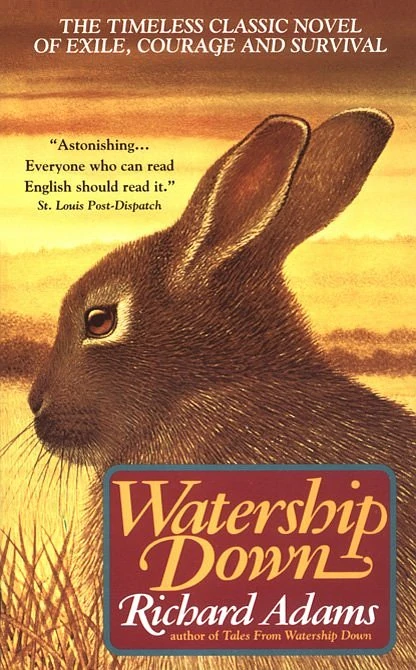
Adams, Richard. Watership Down.
        The Plague Dogs
Applegate, Katherine.  The One And Only Ivan.
Bakker, Robert T. Raptor Red.
Beagle, Peter S.  The Last Unicorn.
Bell, Clare. The Books Of The Named:
        Ratha's Creature.
        Clan Ground.
        Ratha and Thistle-Chaser.
        Ratha's Challenge.
        Ratha's Courage.
Brin, David.  The Uplift Saga.
        Sundiver.
        Startide Rising.
        The Uplift War.
        Brightness Reef.
        Infinity's Shore.
        Heaven's Reach.
Burnford, Sheila. The Incredible Journey.
Clement-Davies, David.  Fire Bringer.
        The Sight.
        Fell.
DiCamillo, Kate.  The Tale Of Despereaux.
Grahame, Kenneth.  The Wind In The Willows.
Hearst, Dorothy.  The Wolf Chronicles.
        Promise Of The Wolves.
        Secrets Of The Wolves.
        Spirit Of The Wolves.
Holt, Christopher. The Last Dogs series.
        The Vanishing
        Dark Waters
        The Long Road
        Journey's End
Horwood, William. Duncton Wood.
Howe, James & Deborah.  Bunnicula series.
Hunter, Erin.  Warriors series.
         Seekers series.
Jacques, Brian.  Redwall series.
Kilworth, Garry Douglas.  Hunter's Moon.
King, Gabriel.  Tag, The Cat series.
        The Wild Road.
        The Golden Cat.
Kipling, Rudyard.  The Jungle Books.
Lackey, Mercedes. Valdemar novels and stories.
Lasky, Kathryn. The Guardians Of Ga'Hoole series.
Lewis, C.S. The Chronicles Of Narnia.
Lloyd, A.R. The Kine Saga
        Marshworld
        Witchwood
        Dragon Pond  
London, Jack.  White Fang.
Morpurgo, Michael.  War Horse.
McAllister, Margaret.  The Mistmantle Chronicles.
        Urchin Of The Riding Stars.
        Urchin And The Heartstone.
        The  Heir Of Mistmantle.
        Urchin And The  Raven  War.
        Urchin And The Rage Tide.
McCaffrey, Anne.  Dragonriders Of Pern series.
O'Brien, Robert C.  Mrs. Frisby And The Rats Of NIMH.
Oppel, Kenneth. Silverwing series
        Silverwing
        Sunwing
        Firewing
        Darkwing
Orwell, George. Animal Farm.
Pierce, Meredith Ann.  Birth Of The Firebringer.
Salten, Felix.  Bambi.
Selden, George.  The Cricket In Times Square.
Sewell, Anna. Black Beauty.
Smith, Dodie.  The Hundred And One Dalmatians.
Smith, Wayne. Thor.
Stewart, Sharon. Raven Quest.
Tod, Michael. God's Elephants; Dolphin Song
          The Dorset Squirrels (aka The Woodstock Saga)
          -- The  Silver Tide
          -- The Second Wave
          -- The Golden Flight   
Wagner, Hillary. The Nightshade Chronicles.
        Nightshade City
        The White Assassin.
        Lords Of Trillium.
Wangerin, Walter Jr. The Book Of The Dun Cow.
Werber, Bernard.  Empire Of The Ants.
White, E.B. Charlotte's Web.
Williams, Tad. Tailchaser's Song.

Comics & Graphic Novels
Busiek, Kurt. The Autumnlands: Tooth and Claw.
Delgado, Ricardo.  Age Of Reptiles.
Dorkin, Evan (author) & Jill Thompson (artist).  Beasts Of Burden: Animal Rites.
Eliopoulos,Chris;  Ig Guara and Colleen Coover.  Lockjaw And The Pet Avengers.
Ennis, Garth.    Rover Red Charley.
Morrison, Grant.
        Dinosaurs Vs. Aliens (with Barry Sonnenfeld).
        We3
Petersen, David.  Mouse Guard.
Spiegelman, Art. Maus.
Vaughn, Brian K. (author) and Niko Henrichon (artist). Pride Of Baghdad.

Games
Bunnies & Burrows. Fantasy Games Unlimited. 1976.  The original animal fantasy game.

Cat. By John Wick.  Housecats protect their humans from invisible monsters.

Council Of Wyrms.  TSR/Wizards Of The Coast.  A boxed set campaign setting designed for dragon player characters in the 2nd edition of the classic fantasy game.  One of the first major focuses on non-humanoid characters.

Mice & Mystics. Plaid Hat Games.  Storytelling boardgame about a group of humans magically turned into mice, trying to rescue their kingdom from an evil sorceress.  Loads of fun.

Squirrel Attack! Hinterwelt Enterprises.  Squirrels from a magical dimension raid Mr. Jones' stash of nuts.

Tales From The Wood. By Simon Washbourne & Mike George.  RPG featuring animals of the British woodlands.

The Noble Wild: An Animal Player's Handbook.  Skirmisher Publishing.  Available in OGC and Pathfinder versions; rules for playing animal PCs in the 3.5 edition of the world's first fantasy RPG. A kindred spirit, and a recent discovery!

Tooth And Claw. A short (8-page) RPG about ferrets.

Thursday, March 19, 2015

Thinking Like An Animal

Noisms over on the Monsters & Manuals blog has an interesting rumination on fantasy dolphins and failures of imagination that bears directly on the Great & Small project.

I've noted before that the best works of animal fantasy don't so much anthropomorphize their animal characters as they zoomorphize their human audience's perceptions.  That is to say, these works don't turn animals into humans with  the serial numbers filed off; instead, they successfully put a human reader's mind into a plausible facsimile of an animal's mind.  Self-centered as we are, we often mistake this for "anthropomorhpizing," but it's a different trick.

One of the reasons Watership Down was such a, well, watershed moment in this kind of fiction is because it de-mystified rabbits, showing human readers that rabbit society was anything but perpetual cuddliness.  A few other animal fantasy works have risen to this challenge, too;  Wayne Smith's horror novel Thor, about the battle of wits between a werewolf and the family dog (told from the titular dog's point of view), really conveys to the reader what it must be like to be a dog: the short attention span, the repetitive thinking, the self-perception of oneself as a member of a human pack, walking through a world dominated by scents, etc.

D&D fails on this project a lot, either treating animals as boring stat blocks with no distinctive traits of their own (sword-fodder, in other words), or playing them up as tropes rooted in pop culture.  As Noisms points out, the AD&D 2nd edition treatment of dolphins has way more to do with human projections than with actual cetacean behavior.  Which would be fine -- gaming is rooted in and reflects pop culture, after all -- except that treating dolphins realistically might have made them more interesting.

My humble project is an effort to bridge that gap.  When I get around to statting dolphins as PCs, (soon...), they're not necessarily going to be romanticized lifeguards for humans and sea elves.  They are a hell of a lot  more interesting than that.

But I think Noisms goes a bit too far in his analysis of animals as inscrutable.  He writes:
We have a failure of imagination when it comes to cute or intelligent animals. We have a natural tendency to impute them with emotions and ideas that are not their own. Animal lovers (I count myself one) are especially guilty of this. It's odd that the more time one spends thinking about and looking at animals, the more one tends to develop this blind spot about them. It often does them a disservice: it infantilises them. It reduces their complex and fundamentally alien nature.
Animals are very different from us, to be sure, but they are not "fundamentally alien."  At least, mammals aren't. 

Evolution is a thing. And there is a thing within that thing called homology, which tells us that related species will share many traits thanks to common ancestry.  We know that the brain structures and functions that govern our emotions and behaviors are homologous within mammals, and some are even homologous across greater taxic expanses (the hippocampal system, for instance, appears to do pretty much in birds what it also does in mammals, which tells us that the last common ancestor of birds and mammals probably had this trait, too).

In short, animal minds are not a complete mystery to us.  Their most recent evolutionary changes create important differences, of course, but our shared heritage as fellow earthlings means that we still have a great deal in common, even mentally.  We actually can plausibly infer a great deal about what it is like to be a bat, as Kenneth Oppel does in his Silverwing trilogy.

The key to animal fantasy is striking the right balance for your audience.  You can find works that almost completely anthropomorphize their animal characters, to the point of dressing them up and putting swords in their paws (Redwall, Mouse Guard, some of the Chronicles Of Narnia...).  You can also find works in the genre that try to complete zoomorphize the reader's perception of the world (as in Robert Bakker's Raptor Red, written entirely in the present tense, with no dialogue at all).  Most animal fantasy falls in the middle somewhere, humanizing their characters enough to make them both sympathetic and empathetic, but also giving the audience a feel for what it must actually be like to be one of those animals.

In the Great & Small game, I plan to have options for all of these interpretations except for completely-anthropomorphized animals.

In the Trucewood Vale setting, the animals are all as sapient as longpaws, can speak fluent Common, and often adventure alongside humanoids.

In the Creepy Crawlies setting, the animal characters are capable of understanding humans with great effort and can talk among themselves, but remain largely in a world of their own.

And in the Legacy Of The Longpaws setting, there will be no magic, no humans, and the animals' cultures will be as realistic as possible.

Stay tuned for all of that later this year.

Wednesday, February 18, 2015

A Sandbox Hex-Crawl.... With Rabbits

Or, Using A Classic Animal Fantasy Novel As A Guide For Animal Fantasy Gaming

This is where it all began, not just for me, but for millions of other people all over the world.  Out of all the works of animal fantasy, Watership  Down is arguably the single novel of the genre with the biggest crossover appeal and success.  The book has enchanted readers for over 40 years, and spawned two animated film adaptations (one for theaters and  one for television).

It wasn't the first, of course.  As I've noted, the narrative convention of using non-human animals as protagonists or major supporting characters is as old as storytelling itself.  But Watership Down had a singular impact on English-language literature, a monster best-seller across decades that became a foundational work for the hidden genre* of animal fantasy.  It is likely that without its success, the world would never have had the proliferation of animal-driven novels and films for children or adults that it has since witnessed.  Without Watership Down, there likely would never have been a Redwall, a Lion King, or a Guardians Of Ga'Hoole.

*I call animal fantasy a "hidden genre" because its body of work is found nested within several other recognized genres, like children's literature, young adult, dramatic fiction, fantasy, sci-fi, and even horror, yet has distinct characteristics of its own that transcend these categories.  Whatever their other narrative techniques, most of these works try not so much to anthropomorphize animal characters as to "animalize" the human reader's perceptions and empathy, making them identify with animal characters on their own, rather than on human, terms. Richard Adams does a masterful  job at establishing this convention of animal fantasy in Watership Down, basing his characters' mannerisms and social interactions on the behavior of actual rabbits, yet convincing us human readers that we are one of them.

Others have reviewed Watership Down far more ably than me (here, here,  and here are three particularly decent ones, for instance). What I want to do is show how this classic animal fantasy novel can be used to model a campaign for animal player characters.

Watership Down is essentially a sandbox hex-crawl through a stretch of the English countryside.  Our Beast Master, Richard Adams, drew up a rough player's map, peopled it with interesting set and wandering encounters, then spurred his party of rabbit PCs to adventure by giving their Seer a disturbing vision that compels them to seek out a new home.  It's virtually a textbook example of how to craft a sandbox setting and make it come alive, even though he had rabbits rather than humans in mind.

And it's the rabbit point of view that really counts here.  Adams describes every location through the filter of a rabbit's senses of smell and hearing, often more vividly than he does using their sense of sight.  This is important, because it highlights the fact that most mammals rely heavily on their sense of smell, with sight taking something of a back seat.  In fact, primates -- including (demi-)humans -- are distinguished from other mammals by our diminished sense of smell, in favor of improved sight.

Adams accounts for this fact in very subtle ways, but it adds up to a distinctly "rabbitish" POV for the novel.  And so it should be in a game of Great & Small, too.  It is easy to fall back on human perceptions and describe every encounter to the players mainly by how it looks. But this would be anthropomorphizing their animal characters a tad too much.  Sight is important for non-human animals, of course, but it's often secondary to their other senses.  BMs wishing to foster a properly animal-centric feel to a G&S session should therefore try to "animalize" their players' conceptions by appealing first to senses other than sight.

Remember that most mammals have red-green color blindness.  Birds and many fish can see into the ultraviolet range (remember "ultravision" from the 2nd Ed. DM's Guide?).  Bats navigate by sonar (that is, hearing).  Snakes "smell" and track by sense of taste.

Taking account of these senses in the descriptions you provide to players before telling them what they see -- as Adams often does with his presentation to the reader of a rabbit's world -- will go a long way to making their characters more than just crawling humanoids with the serial numbers filed off.

Another trick Adams pulls off subtly is showing how differently animals think from humans, while still keeping them relatable.  He never gives the exact dimensions of any object or space that Hazel, Fiver, Bigwig, and the others encounter.  He refers to any number larger than four as "lots" or "Thousands" (the name of the character Fiver  is translated from a rabbit word meaning "Little Thousand," or "one more than four"; he was the fifth kitten born in his litter).  Animals, or at least rabbits in Adams' story, aren't as  precisely mathematical as humans can be.

This can be taken as a license to be vague or imprecise in mapping areas, depending on the species.  Places or things will be "really big," "vast," "smaller than a cat but bigger than a squirrel," etc.  Of course, it's probably still a good idea for the BM to keep as precise a picture of encounters as she wants, but there's no reason she has to share every single detail with the players' characters the way she might if they were (demi-)human. 

Finally, Adams shows rabbits struggling to do things that humans take for granted, like manipulate objects or deduce the function of simple mechanisms.  BMs confronting their players with otherwise "mundane" tasks like turning a door knob, rolling over a rock, or flipping a switch, should call for lore checks.  The Scout niche is designed to excel at these sorts of things, of course, but any animal should be given an opportunity to try.

On the other hand, animals should excel at things that (demi-)humans find difficult, such as three-dimensional navigation (for birds and fish and possibly arboreal species), acrobatics, or plant and animal lore for the local ecology.  Animals have disadvantages compared to (demi-)humans in the OSR rules, but don't forget that even the simplest animal can do things from the start that (demi-)humans have to call on magic or technology to accomplish (how many other OSR games allow you to fly at 1st level?).

All that said, Watership Down also helps answer the most common question I've gotten when pitching this game to others: what do animal characters do?

Turns out, they do mostly what two-legged, sword-swinging characters do: go on quests, fight for honor and status, fall in love.  There's no reason that a "standard" adventure or campaign idea can't be run with animal player characters.  You just have to focus on the different ways they're likely to perceive your encounters.

There is one major difference, though, and that's stuff.  Animals, in general, aren't interested in treasure or possessions for their own sake, the way (demi-)humans are.  This removes a major adventuring motivation from the heart of the OSR experience, but I'll deal with how to manage that change in a future post.

Monday, February 9, 2015

Campaign Scheme: The Creepy Crawlies, Pt. 1

Time now for a look at what to actually do with animal player characters.  I've outlined three broad campaign setting ideas for the game, and I'll reveal a little bit about each of them as the development of the project moves forward.

First up: the Creepy Crawlies.

What is Creepy Crawlies?  A campaign of occult mystery, in which the PCs are "children of the night" dedicated to protecting the world from the true horrors of the universe.  Creepy Crawlies are allied with an ancient order of monster-slaying canids called the Watch Dogs, and represent the first line of defense against the lingering ghosts of evolution.  As the sorts of animals often summoned by the presence of nightmarish infestations, Creepy Crawlies are in a perfect position to infiltrate and, if necessary, strike first against both conventional monsters and the madness of the Neverspawn.

Character Options:  Species most suitable to a Creepy Crawlies campaign include bats, black cats, black dogs, lizards, owls, rats, ravens, snakes, toads, wolves, and possibly even sentient swarms of spiders or other "bugs."  All of the standard niches are available, along with a new niche, the Familiar (a spirit-possessed animal capable of using standard OSR magic, but in a different way than clerics and magic-users). Other possible new niches include the Psychopomp (an animal dedicated to escorting spirits of the dead to their final reward) and the Shapeshifter (do you really need an explanation for this one?).

Inspirations:
  • Beasts Of Burden by Evan Dorkin (author) and Jill Thompson (artist) (Dark Horse Comics): a group of neighborhood dogs (plus one cat) protect their unknowing humans from horrors of the occult (even teaming up with Hellboy at one point!).
  • Thor by Wayne Smith: man's best friend confronts man's worst nightmare in this family dog vs. werewolf tale that  became the basis of the not-terrible movie Bad Moon.  The novel, told from the dog's point of view, is far superior.
  • Cat: an RPG about house cats protecting their humans from monsters they can't see.
Resources: 
Threats & Foes:
Evolution has a secret: extinction is not forever.  The world is haunted by the angry spirits of species long gone, and worse, of those never born.  There is a place -- the Lingering World -- where such terrors conglomerate and push against the Membrane between realms.  Sometimes, they break through, desperate to either replicate unfettered, or annihilate all competitors.

In the Lingering World, two dread god-things vie for supremacy: the Winnower, embodiment of natural selection, seeks to eliminate all disorder and confine reality to an eternity of cold pattern and stasis; and the Progenitor, source of life unchecked, wants only to spawn without restriction or reason.  Both of them birth broods of impossible form to people their eternal armies, and sometimes that battle seeps into our world.

The Progenitor is the source and  protector of Neverspawn, beasts of illogical congerie and ghosts of lost possibility, phylogenies that might have been.  Their only goal is to replicate and consume, invading all niches and supplanting all other life.

The  Winnower's minions are more conventional, possessing anatomies that, while monstrous, still "make sense" to a terrestrial vertebrates' perceptions.  Though not inflexible, their forms and powers are somewhat predictable, and this makes them easier to fight... in theory.

Monsters who serve the Winnower (sometimes unknowingly) pursue agendas that promote death, entropy, and extinction.  They include many of the monsters of traditional gothic horror.

Creatures who serve the Progenitor have no standard form or appearance, unless they are members of Neverspawn cults from our own world.

Both god-things have human and animal servants, as well, and Creepy Crawlies often infiltrate their ranks to learn more about and subvert their plans before it's too late.

Adventures:
Creepy Crawlies adventures are often investigations of hauntings, disappearances, bizarre sightings, and other unexplained phenomena, climaxing in "lair-crawls" into the heart of the menace's stronghold, to confront, contain, or eliminate the beast on its own turf.  Along the way, Creepy Crawlies will often use their talents to scare off humans and other animals, giving them a fright for their own good.

Some examples:
  • Bloodless bodies have begun to appear in the area, leading the Creepy Crawlies to suspect the presence of a vampire.  But they discover that it is, in fact, a shape-shifting giant trigonotarbid direct from the Lingering World, who has taken up residence in a dilapidated old house and is about to hatch its young upon the locals.
  • The party investigates sightings of a cryptid, such as Bigfoot, the Chupacabra, a unicorn, or some other "impossible" animal.  They discover that she is the last of her kind in our world, and is being stalked by terrible minion of the Winnower called the Eater of Last Things.  Do the PCs help this animal-that-should-not-be, or do they help the Eater carry out its duty to evolution, risking their own deaths in the process?