Showing posts with label Watership Down. Show all posts

Thursday, March 19, 2015

Thinking Like An Animal

Noisms over on the Monsters & Manuals blog has an interesting rumination on fantasy dolphins and failures of imagination that bears directly on the Great & Small project.

I've noted before that the best works of animal fantasy don't so much anthropomorphize their animal characters as they zoomorphize their human audience's perceptions.  That is to say, these works don't turn animals into humans with  the serial numbers filed off; instead, they successfully put a human reader's mind into a plausible facsimile of an animal's mind.  Self-centered as we are, we often mistake this for "anthropomorhpizing," but it's a different trick.

One of the reasons Watership Down was such a, well, watershed moment in this kind of fiction is because it de-mystified rabbits, showing human readers that rabbit society was anything but perpetual cuddliness.  A few other animal fantasy works have risen to this challenge, too;  Wayne Smith's horror novel Thor, about the battle of wits between a werewolf and the family dog (told from the titular dog's point of view), really conveys to the reader what it must be like to be a dog: the short attention span, the repetitive thinking, the self-perception of oneself as a member of a human pack, walking through a world dominated by scents, etc.

D&D fails on this project a lot, either treating animals as boring stat blocks with no distinctive traits of their own (sword-fodder, in other words), or playing them up as tropes rooted in pop culture.  As Noisms points out, the AD&D 2nd edition treatment of dolphins has way more to do with human projections than with actual cetacean behavior.  Which would be fine -- gaming is rooted in and reflects pop culture, after all -- except that treating dolphins realistically might have made them more interesting.

My humble project is an effort to bridge that gap.  When I get around to statting dolphins as PCs, (soon...), they're not necessarily going to be romanticized lifeguards for humans and sea elves.  They are a hell of a lot  more interesting than that.

But I think Noisms goes a bit too far in his analysis of animals as inscrutable.  He writes:
We have a failure of imagination when it comes to cute or intelligent animals. We have a natural tendency to impute them with emotions and ideas that are not their own. Animal lovers (I count myself one) are especially guilty of this. It's odd that the more time one spends thinking about and looking at animals, the more one tends to develop this blind spot about them. It often does them a disservice: it infantilises them. It reduces their complex and fundamentally alien nature.
Animals are very different from us, to be sure, but they are not "fundamentally alien."  At least, mammals aren't. 

Evolution is a thing. And there is a thing within that thing called homology, which tells us that related species will share many traits thanks to common ancestry.  We know that the brain structures and functions that govern our emotions and behaviors are homologous within mammals, and some are even homologous across greater taxic expanses (the hippocampal system, for instance, appears to do pretty much in birds what it also does in mammals, which tells us that the last common ancestor of birds and mammals probably had this trait, too).

In short, animal minds are not a complete mystery to us.  Their most recent evolutionary changes create important differences, of course, but our shared heritage as fellow earthlings means that we still have a great deal in common, even mentally.  We actually can plausibly infer a great deal about what it is like to be a bat, as Kenneth Oppel does in his Silverwing trilogy.

The key to animal fantasy is striking the right balance for your audience.  You can find works that almost completely anthropomorphize their animal characters, to the point of dressing them up and putting swords in their paws (Redwall, Mouse Guard, some of the Chronicles Of Narnia...).  You can also find works in the genre that try to complete zoomorphize the reader's perception of the world (as in Robert Bakker's Raptor Red, written entirely in the present tense, with no dialogue at all).  Most animal fantasy falls in the middle somewhere, humanizing their characters enough to make them both sympathetic and empathetic, but also giving the audience a feel for what it must actually be like to be one of those animals.

In the Great & Small game, I plan to have options for all of these interpretations except for completely-anthropomorphized animals.

In the Trucewood Vale setting, the animals are all as sapient as longpaws, can speak fluent Common, and often adventure alongside humanoids.

In the Creepy Crawlies setting, the animal characters are capable of understanding humans with great effort and can talk among themselves, but remain largely in a world of their own.

And in the Legacy Of The Longpaws setting, there will be no magic, no humans, and the animals' cultures will be as realistic as possible.

Stay tuned for all of that later this year.

Wednesday, February 18, 2015

A Sandbox Hex-Crawl.... With Rabbits

Or, Using A Classic Animal Fantasy Novel As A Guide For Animal Fantasy Gaming

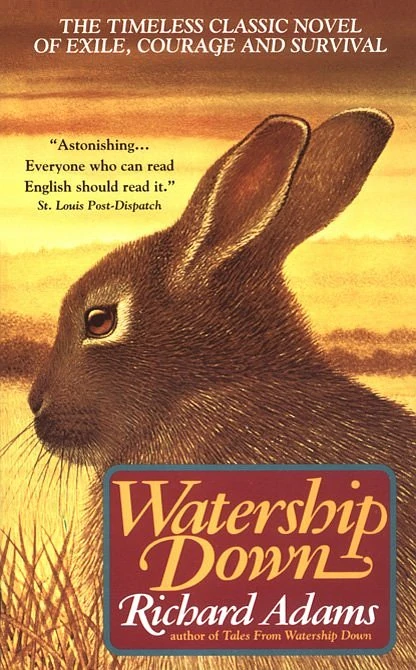
This is where it all began, not just for me, but for millions of other people all over the world.  Out of all the works of animal fantasy, Watership  Down is arguably the single novel of the genre with the biggest crossover appeal and success.  The book has enchanted readers for over 40 years, and spawned two animated film adaptations (one for theaters and  one for television).

It wasn't the first, of course.  As I've noted, the narrative convention of using non-human animals as protagonists or major supporting characters is as old as storytelling itself.  But Watership Down had a singular impact on English-language literature, a monster best-seller across decades that became a foundational work for the hidden genre* of animal fantasy.  It is likely that without its success, the world would never have had the proliferation of animal-driven novels and films for children or adults that it has since witnessed.  Without Watership Down, there likely would never have been a Redwall, a Lion King, or a Guardians Of Ga'Hoole.

*I call animal fantasy a "hidden genre" because its body of work is found nested within several other recognized genres, like children's literature, young adult, dramatic fiction, fantasy, sci-fi, and even horror, yet has distinct characteristics of its own that transcend these categories.  Whatever their other narrative techniques, most of these works try not so much to anthropomorphize animal characters as to "animalize" the human reader's perceptions and empathy, making them identify with animal characters on their own, rather than on human, terms. Richard Adams does a masterful  job at establishing this convention of animal fantasy in Watership Down, basing his characters' mannerisms and social interactions on the behavior of actual rabbits, yet convincing us human readers that we are one of them.

Others have reviewed Watership Down far more ably than me (here, here,  and here are three particularly decent ones, for instance). What I want to do is show how this classic animal fantasy novel can be used to model a campaign for animal player characters.

Watership Down is essentially a sandbox hex-crawl through a stretch of the English countryside.  Our Beast Master, Richard Adams, drew up a rough player's map, peopled it with interesting set and wandering encounters, then spurred his party of rabbit PCs to adventure by giving their Seer a disturbing vision that compels them to seek out a new home.  It's virtually a textbook example of how to craft a sandbox setting and make it come alive, even though he had rabbits rather than humans in mind.

And it's the rabbit point of view that really counts here.  Adams describes every location through the filter of a rabbit's senses of smell and hearing, often more vividly than he does using their sense of sight.  This is important, because it highlights the fact that most mammals rely heavily on their sense of smell, with sight taking something of a back seat.  In fact, primates -- including (demi-)humans -- are distinguished from other mammals by our diminished sense of smell, in favor of improved sight.

Adams accounts for this fact in very subtle ways, but it adds up to a distinctly "rabbitish" POV for the novel.  And so it should be in a game of Great & Small, too.  It is easy to fall back on human perceptions and describe every encounter to the players mainly by how it looks. But this would be anthropomorphizing their animal characters a tad too much.  Sight is important for non-human animals, of course, but it's often secondary to their other senses.  BMs wishing to foster a properly animal-centric feel to a G&S session should therefore try to "animalize" their players' conceptions by appealing first to senses other than sight.

Remember that most mammals have red-green color blindness.  Birds and many fish can see into the ultraviolet range (remember "ultravision" from the 2nd Ed. DM's Guide?).  Bats navigate by sonar (that is, hearing).  Snakes "smell" and track by sense of taste.

Taking account of these senses in the descriptions you provide to players before telling them what they see -- as Adams often does with his presentation to the reader of a rabbit's world -- will go a long way to making their characters more than just crawling humanoids with the serial numbers filed off.

Another trick Adams pulls off subtly is showing how differently animals think from humans, while still keeping them relatable.  He never gives the exact dimensions of any object or space that Hazel, Fiver, Bigwig, and the others encounter.  He refers to any number larger than four as "lots" or "Thousands" (the name of the character Fiver  is translated from a rabbit word meaning "Little Thousand," or "one more than four"; he was the fifth kitten born in his litter).  Animals, or at least rabbits in Adams' story, aren't as  precisely mathematical as humans can be.

This can be taken as a license to be vague or imprecise in mapping areas, depending on the species.  Places or things will be "really big," "vast," "smaller than a cat but bigger than a squirrel," etc.  Of course, it's probably still a good idea for the BM to keep as precise a picture of encounters as she wants, but there's no reason she has to share every single detail with the players' characters the way she might if they were (demi-)human. 

Finally, Adams shows rabbits struggling to do things that humans take for granted, like manipulate objects or deduce the function of simple mechanisms.  BMs confronting their players with otherwise "mundane" tasks like turning a door knob, rolling over a rock, or flipping a switch, should call for lore checks.  The Scout niche is designed to excel at these sorts of things, of course, but any animal should be given an opportunity to try.

On the other hand, animals should excel at things that (demi-)humans find difficult, such as three-dimensional navigation (for birds and fish and possibly arboreal species), acrobatics, or plant and animal lore for the local ecology.  Animals have disadvantages compared to (demi-)humans in the OSR rules, but don't forget that even the simplest animal can do things from the start that (demi-)humans have to call on magic or technology to accomplish (how many other OSR games allow you to fly at 1st level?).

All that said, Watership Down also helps answer the most common question I've gotten when pitching this game to others: what do animal characters do?

Turns out, they do mostly what two-legged, sword-swinging characters do: go on quests, fight for honor and status, fall in love.  There's no reason that a "standard" adventure or campaign idea can't be run with animal player characters.  You just have to focus on the different ways they're likely to perceive your encounters.

There is one major difference, though, and that's stuff.  Animals, in general, aren't interested in treasure or possessions for their own sake, the way (demi-)humans are.  This removes a major adventuring motivation from the heart of the OSR experience, but I'll deal with how to manage that change in a future post.